Though Numenera tends to not have much math or complicated steps when performing an action, having access to quick macros in online play can help keep a game running along smoothly.
Roll20s macros involve their own language which is worth learning, but when using the official Cypher Systems character sheet, creating macros as a player or GM is actually quite simple and doesn’t require much if any familiarity with writing macros from scratch. This essay will show you how to make simple macros that call to functions on your character sheet, allowing you to speed up the flow of your game and provide you with ease of access to your most used abilities. This is a great solution for anyone looking for a smoother game, but is also perfect for those with limited screen real estate.
While this essay doesn’t require you to understand any of Roll20’s macro coding language, it does assume some familiarity with the Cypher Systems character sheet in Roll20, though this is a pretty simple character sheet to jump into and understand.
Setting up the Cypher Systems Character Sheet
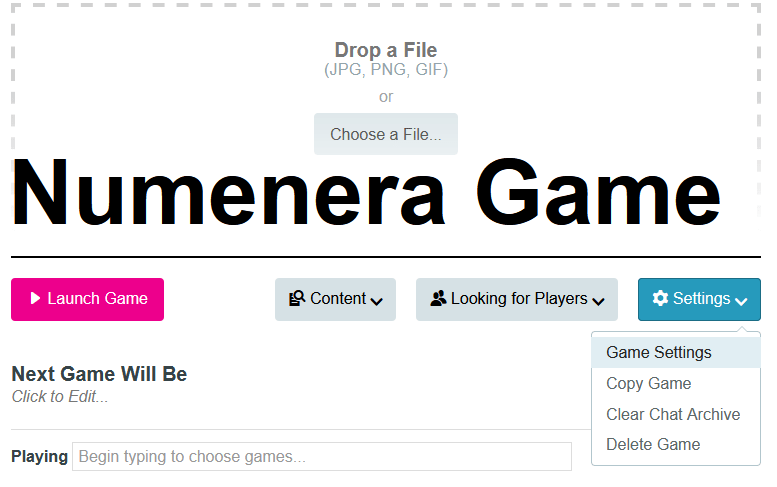
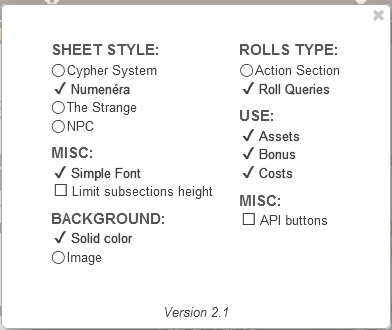
The settings for a Roll20 game’s character sheet can be found in the “Game Settings” area and under “Character Sheet Template.”
The Cypher Systems character sheet in Roll20 offers a few options when it comes to how you want each roll to be processed. The one’s we’re concerned about for this essay include the “ROLLS TYPE:” and “USE” section. While you can take the the information from this essay and tailor it to your liking, I will be basing this process on a character sheet which has the ROLLS TYPE set to “Roll Queries” and under USE, “Assets” “Bonus” and “Costs” will all be checked.
This means that every time a macro is clicked, a prompt will show up for the player, asking if there’s any bonus to the roll, what the Difficulty is, or if it is known, how much Effort the player wishes to apply to the roll, whether or not there are any Assets, or whether or not there’s an additional cost in Stat Pool points for the action in question.
Entering in all this information results in a fairly straightforward readout of the result of the dice, what influenced the Difficulty Level, how many points ought to be taken from the player’s pool and whether or not the action was a success or not.
Finding the Macro Code
Every time you click one of the options in a character sheet in Roll20, a series of code is executed that makes calls to specific stats on the sheet, and factors them into the game’s rules for “success or failure.”
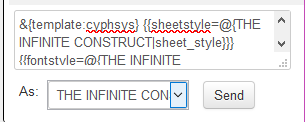
This code is usually hidden, but the trick to recovering it is to click into the chat box and once your cursor begins blinking, simply press “UP” on the arrow key. This will bring up the last command you issued.
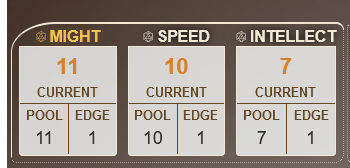
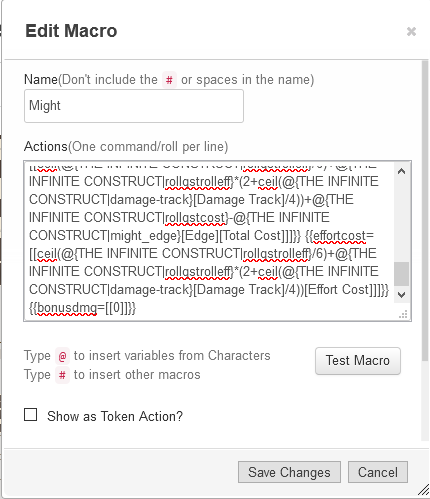
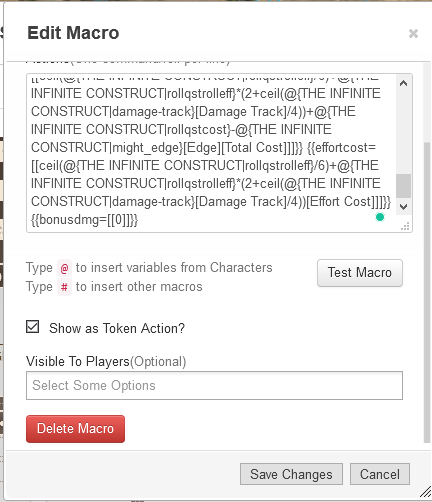
Clicking “Might” in a Cypher System character sheet will ask Roll20 to make a roll using the rules of the Cypher System. Once this roll has been performed, we can then click into the chat box and press UP on the arrow keys to grab the code for Rolling “Might.” It will look something like this.
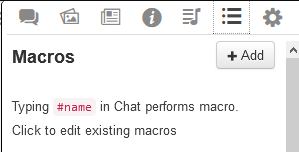
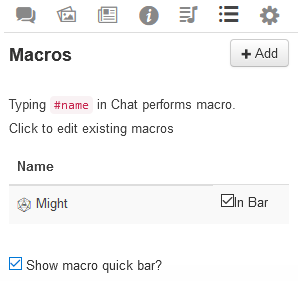
You don’t need to understand any of this code to make a macro out of it. Just take that text, head on over to the “Collection” tab in Roll20s menu, click “+Add” in the Macros section, name the macro “Might” and then paste the code you just grabbed from the chat text into the “Actions” box. Go ahead and test your macro to make sure it’s working perfectly, then save it and you now have the ability to make a “Might Roll” without needing to open your character sheet. Roll20 will prompt you for the Roll Queries each time you use this macro, and it will calculate it just as if you clicked it in the character sheet itself.
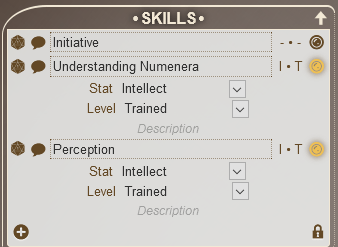
Let’s take another example. This example character is Trained in Perception, a skill likely to get a lot of use and therefore perfect for a macro.
In order to get the code for the Macro, we’ll need to roll perception out of the character sheet—as you might have noticed, creating Macros this way means that you’ll have to roll for the sake of getting the code, meaning that this is best done before or after a game session.
Click the die next to the Perception skill and Roll20 will ask you for some information, then make a Perception Roll. Go into the text chat and press UP on the arrow keys to grab the Macro code. As a rule of thumb, I always use cut instead of copy when moving the code over as it clears my text chat so that I don’t accidentally grab the wrong code if I’m building a lot of macros.
Add a new Macro, name it “Perception” and paste the code you cut from the text chat into the Actions box. Test out the macro to make sure it indeed rolls accurately, and then save the Macro.
Macro Buttons
While you can just click on the macro titles in the macro section to use them, the real goal here is to have these macros be clickable buttons on the main screen for ease of access. Before we do this, however, we’ll need to decide who will be using this Macro. If you are a GM building macros for your players, you’ll need to make sure they have access to this macro. When editing a Macro in the edit section, at the bottom you can decide if no players, all players, or only certain players can access this. Choose the player this ability corresponds to and save the changes.
You’ll want to ask this player to make sure that they check “In Bar” if they wish to see the macro at the bottom of the screen. Here they can rearrange the macros, or even assign different colors to help navigate a screen with a lot of different abilities.
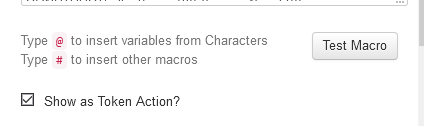
By checking “Show as Token Action” in the Macro edit section, the Macro buttons will only appear when the token associated with this character sheet is selected on the map. This is really helpful for assigning “Initiative” to a macro as rolling Initiative and being added to the turn order requires a token to be selected first.
You can also assign macros to items on the character sheet which do not involve a die roll. This is helpful for special abilities which may be beneficial to have the text called up as it will detail the related Stat, the cost, and whatever information you include about the ability.
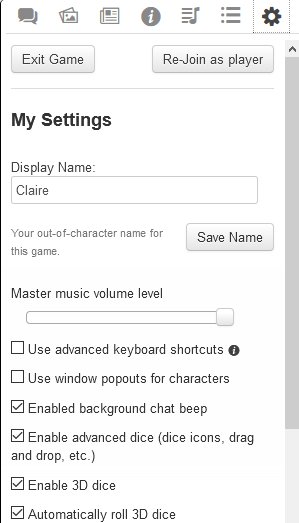
Virtual Tabletops are never a 1:1 replacement for gaming at an actual table. That said, there are a number of advantages to using a service like Roll20. Though the Cypher System is by no means a numbers-heavy set of rules, having a simple button press for commonly used actions is a great way to keep the game flowing and can even help players who aren’t as used to navigating Roll20s interface or character sheets. GMs hosting games might benefit from taking some time out to build macros using this method for their players and just walking them through the step of making sure they can access them. If you still want to retain that tabletop feel or the theater of everyone seeing a roll result, turning on 3D dice can do the trick quite nicely.
In a future entry, I’ll go into how to create a universal d20 macro that just calculates a flat d20 roll against the Cypher System’s difficulty chart and displays it in the chat with the correct formatting. This requires a bit more setup and some editing of macro code, so it’s a bit more involved. For now, though, getting used to building macros for player abilities is a great way to take advantage of one of the strengths of using a service like Roll20.
The Black Riage towers over Elithal and their father, Baffir. Just outside of the green comfort of the Ba-Adenu Forest, the mountains look as if someone tore a portion of the sky out of existence and left a dark maw of menacing rock in its place—as if what was beyond the fabric of reality itself was forever hard, lifeless, and cold. Elithal grips the shaft of their staff made of shimmering braided metal and synth and follows Baffir into the opening of Cerdyn’s Path. It had been three days that their small village nestled in the forest had been without power. They couldn’t purify their water as a result. People were getting sick. Worse, a special grid of repurposed numenera that had kept a parasitic insect species at bay for several generations was also starting to malfunction.
Their only hope now was to search out a spot the village scouts claimed had a cache of power batteries. The elder nano of the village, Orifon, claimed she could repurpose whatever they found—but apparently a group of Laak’s had called the area home and were likely to defend it against any intruders.
Baffir stops, brings his hand up and turns to his child, raising a finger to his lips. They were to communicate with hand gestures and blinks now—a tradition that kept his people alive and hidden for centuries. Baffir speaks in silence this way, warning Elithal that they are now entering the Laak’s territory, the creatures’ home, and were to treat the area with respect. The hair on Elithal’s neck stands on end as they look up at the rocky heights of the Black Riage, imagining the parietal eyes of the Laaks staring down on them, waiting to pounce, and bite down with a mouth full of twisted venom.
They move cautiously through a winding path that takes them higher up into the mountain range, a path lined with rocks that are known to whisper strange cryptic messages to travelers who take the time to listen; sometimes they are said to answer profound questions. Elithal imagines that were the situation different, they would have the time to witness this phenomenon, but the village was counting on them and their father to make haste. Stopping before the mouth of a cave entrance—the Laak’s lair, the smell of death and blood pours out and fills the air; Elithal imagines stepping into a great living beast…not that such a thing in the Ninth World would be impossible. At the crest of the cave entrance, a creature sits perched, staring down at Elithal and Baffir. It appears to be both bird and plant at once, greenish feathers, with a sharp beak and protruding flower petals for eyes. It shakes itself like a Seskii and darts off to the distance, making a sharp knocking sound as it does. Father and child enter the cave.
It wasn’t long before they came upon the first dead Laak, and then another, and then another, and then another. It was clear to Elithal and their father that they weren’t the first foreigners here. All of the bodies were violently torn into; some areas look like they’re scorched by some kind of ancient fire. Blood lines the floor and the walls of the cave. A metallic screeching emerges from somewhere further in the cave, along with flashes of blue and green light. It comes in waves, pulses of sound and light that freeze Elithal quicker than any of the Laak venom could’ve dared to. A hand on their wrist snaps them out of it; Baffir, who blinks three times, tells his child to be brave, reminding them that it is their courage that keeps the village alive.
The spherical shape of a hovering machine comes into view now as they move further into the cave. Positioned above the chache of batteries and other metallic odds and ends, the machine lets forth a burst of radiant light from its center, slicing open one of the batteries and then pausing, emitting several audible beeps and hums. Elithal had heard of these before, ancient machines who seem to serve a purpose now unknown to the humans of the Ninth World. All they do is destroy—and this one has found the cache of energy batteries. Elithal’s father turns to them after reaching into his pack to retrieve a cylindrical device fixed to a leather band; he wraps it around Elithal’s wrist before showing them how to aim it forward and use the rubber loops that their fingers fit into to activate it. He blinks a few times and motions with his hands to let them know this is a last resort. This cryptic device will only work once.
Baffir stealthily moves toward the machine, stopping only a half-a-dozen feet in front of it. He pounces, silently, with his metal and crystal tipped spear aimed to take down the machine. Elithal had not known a material in the world their father couldn’t make quick work of with that weapon. With lightening reflexes, the machine twitches an antennae in the direction of its attacker, thrusting out one of its six arms and piercing the body of Baffir, who lets out a cry of anguish as blood flows from his new wound. The machine spins around and lets out a burst of light that severs his arm. It lets out an ear piercing sound and fills the cave with a terrible green light. Elithal cowers behind a rock, but they know the machine can still see them still with its magic. They shake as they remember the device on their wrist, one of the many cryptic, powerful devices found scattered throughout the world, sometimes capable of mysteries and wonders all on their own. They steeled their nerves by playing a lullaby in their minds, one of the songs their father used to sing to help them fall asleep. They breathe. They prepare.
Elithal leaps over the rocks and dashes toward the machine, screaming as they rage toward the floating, six-limbed monstrosity. The machine’s central eye begins to glow a hot greenish white, but Elithal is faster. They thrust their hand out and squeeze, pulling the rubber loops laced around their finger as the cylinder releases a stream of thick foam at the machine, covering its body. A strange smell fills the air and the machine twitches. The light from the machine fades as in the next move Elithal forces their spear into the its body, easily piercing its metal surface, now transformed into a brittle, glass-like substance. Consumed with fear and rage, Elithal pulls the spear back and thrusts again, multiple times, over and over again, as the machine lets out more ear piercing screams, twitching, frantically flailing its arms as it falls to the stone ground; the sound of metal smacking on rock fills the bloodied halls of the cave.
The threat now removed, Elithal races over to their father, cradling his body in their arms. For a few moments, Baffir is unresponsive, but Elithal stirs him to life with his cries. “Elithal,” Baffir manages to struggle out only a few words. He gestures to the slain machine, “you” he says to his child, “now you are a Glaive. You will protect our home.” The light fades from Baffir’s eyes, and Elithal sits in the silence and darkness.
They prays over their father’s body before retrieving what’s left of the batteries. They will return for a proper burial. Right now, securing the village is all that matters, it is the job of its Glaive.They set off back to the village, the home they are now sworn to protect.
Building Your Glaive
When it comes to getting the most out of the character types in Numenera, it is not uncommon to draw parallels to that of “classes” found in other games. Where it concerns the “Glaive,” comparisons to fighters and barbarians, the broader category of physical damage dealers are likely to spring up. This, of course, isn’t wrong; any game of Numenera is sure to have combat scenarios and physical challenges where a certain character’s strengths in their Might and Speed stats will come into focus and make the difference between success and failure. But in a game where combat isn’t always the focus, often ends in a few rounds, and doesn’t grant XP, how might one use the archetypes frequently associated with the Glaive in a creative and rewarding way?
Fortunately, Numenera’s use of the Cypher System allows players to build out Glaives with a high degree of customizability, offering mechanical functions when it comes to excelling in combat and succeeding in strenuous physical challenges, but also providing the foundation for great interactive storytelling.
The numbers and resources are present in Numenera’s core rulebooks to build out an excellent fighter or warrior, but when it comes to building your Glaive, taking advantage of the inherent narrative core at the center of these rules is essential for an engaging Numenera experience.
Numenera takes place in a setting known as the Ninth World, a vision of the earth a billion years in the future where a young and varied human species finds themselves among the detritus of vast technological civilizations long gone. “Glaive” is a word used among these people to, as described in the core rules, refer to “hunters, guardians, soldiers […] scouts, warlords, bandits, and even athletes” (Numenera: Discovery 28). It’s a term Ninth Worlders reserve for anyone who may “command abilities far beyond those of a typical person with a sword” (28).
Glaive does have a contemporary definition as well; it isn’t merely a fictional term from Monte Cook Games. Most specifically, it refers to a kind of multibladed weapon whose design is found in Europe, Japan, China, Korea, and Russia. In some of its most basic translations, it simply means “Sword.”
In Numenera, it is rarely appropriate to apply such direct meanings from our world to the Ninth World. The people of the Ninth World live in the wake of civilizations that were so expansive as to render any possible knowledge of the 21st Century and earlier impossible to ever know or understand. That said, I do believe that the spirit of this word applies well to understanding, at the very least on a meta level, what a Glaive is, what a Glaive represents: that of the precision and lethality of a weapon itself. And in the Ninth World, precision and lethality rise to extraordinary heights whether we’re talking about weapons or the people themselves. It is even likely that, for some Glaives, the line between weapon and person is a constant blur.
The implications for RPG combat scenarios are clear, and the fighting abilities afforded to Glaives from the Numenera core rulebooks, expansions, and even sources like the Cypher System Rulebook provide players with excellent ways to eliminate deadly threats. When it comes to who these people are as characters though, building a Glaive should naturally come with the understanding that these are people who stand apart from the crowd in their physical capabilities; they are living weapons and this often guides their place in society, whether they’ll be desired on the front lines of war, leading expedition teams into exotic and potentially dangerous territories, or ascending the ranks of black market organizations tucked into the shadows of the Ninth World’s cities.
Glaives can cut deep into the Ninth World itself to make way for new discovery, and can clear paths for humanity’s destiny.
If you’re unfamiliar with character creation in Numenera and the Cypher System more broadly, the process is quite simple. Every character is most succinctly understood in a sentence made up of three distinct parts; every character is an “Adjective” “Noun” who “Verbs.” Our Adjectives are known as “Descriptors,” our Nouns are “Types,” and our Verb is our “Focus.” Descriptors, Types, Foci: all parts are coded to represent specific statistical advantages and numerical RPG crunchiness, of course, but they also communicate something profound about who a character is.
Consider the opening scene with young Elithal. We could imagine them as a Heroic Glaive who Shepherds the Community. Mechanically speaking they will of course get specific stat advantages and disadvantages from the “Heroic” descriptor, and it may be enough for a player to be satisfied with this. But to take full advantage of the dynamic and narrative focus of the Cypher System, we could imagine what has made Elithal Heroic. Surely the loss of their father, which summoned in them a courage to stand up to the Disassembler, might have started Elithal down the path of a hero—and it is indeed the case that the “Heroic” descriptor has some extra rules for considering how the “Heroic” archetype can play out over the course of a game, but perhaps it is Elithal’s natural quickness that resulted in their action, then we might consider a descriptor such as “Swift,” or even “Exacting.” Perhaps the loss of their father leads them to become a “Strong,” “Strong-Willed,” or “Rugged” Glaive. Since we have decided Elithal will become a Glaive, their prowess and ability in combat is guaranteed; the descriptor is free to either double-down on Eltihal’s combat abilities, or extend them into something more dynamic or rooted in their backstory. Maybe Elithal leaves their town and adopts a secretive life, looking to put their past behind them, and so “Mystical,” or “Stealthy” might fit the concept we’re building for Elithal. Character creation, even for what we might assume is a typical “fighter” character, tells a story.
For their focus, we might take inspiration from Elithal’s father’s dying words, that of protecting the village. “Shepherds the Community” is an excellent consideration here, as could “Defends the Weak.” Perhaps their encounter with the Disassembler taught them the importance not merely of strength, but also being precise and intentional in combat, and so a focus like “Wields Power With Precision” could work. At the same time, perhaps Elithal’s background of living in the Ba-Adenu Forest is most notable, and so they might be a Glaive who simple “Lives in the Wilderness.”
All of these combinations can do the work of finely integrating backstory, concept, and traditional RPG party roles into one. They can allow the player to double down on the Glaive’s fighting capacity: a Strong Glaive who Wields Two Weapons at once is easy enough to picture and understand; they will have the mechanical benefits of increased strength and athletic ability from their Strong descriptor and will be given the option to make two attacks at once from their Focus. Alternatively, one might wish to bend the expectations of a Glaive and construct a Mystical Glaive who Dances with Dark Matter. Such a character would maintain all of the typical strengths and fighting abilities afforded to the Glaive type, but would gain an added bonus to their Intellect from the Mystical descriptor, along with a more intuitive sense of the numenera itself and even the esotery “Hedge Magic.” Their Focus, Dances with Dark Matter, not only has a rhetorical flair unto itself, but will even give this Glaive the ability to fly on wings of dark, esoteric matter once they reach Tier 2.
What in many other RPGs is often only possible through multiclassing or the creative use of rules that cover multiple books, is able to be built directly into a character in Numenera with the core materials. The Descriptor and Focus of a Glaive allows a player to build dynamic, exotic, and unique fighters, while at the same time having rhetorical weight that speaks to who their characters have been, who they are, and who they will become.
It is for these reasons that simply referring to “Glaives” as the “Fighter Class” in Numenera dramatically sells the experience short.
Numenera is a game that aspires to achieve gripping narrative experiences. That said, it is still an RPG and many of the abilities lean toward mechanical combat anyway, especially where it concerns the Glaive. Deep consideration for a character’s backstory and their overall “essence” and flavor is critical for a great experience, but making sure that a character is mechanically sound is always of importance.
It is quite difficult in the Cypher System to construct a character “poorly.” One of the great advantages of this system is that characters are typically very good at what their concept sets out to do. Much of this is due to the fact that the core stats of the game are simple and straightforward; Glaives come out of the box with higher Might and Speed. In combination with their additional points and whatever bonuses their Descriptor will give them, players aren’t taxed with building an effective Glaive so much as they are instead asked to build the kind of Glaive they wish to play.
Players who wish to base their Glaives on raw muscular strength and the ability to take a more than a couple of punches will likely boost their Might stat and may wish to seek out a Descriptor that reinforces this (though the bonus stat points from the Glaive type still allows the freedom to pick a Descriptor which will diversify a character’s options and abilities). Foci don’t have a direct influence on a characters stats, but they do somewhat represent what a character does with their stats. For the muscular, Might-heavy Glaive, it will be worthwhile to consider how a higher Might stat will work with the abilities gained from their Focus. Special Abilities from the Focus “Bears a Halo of Fire,” for example, do require expenditure from a character’s Intellect pool to be used, but for a Glaive with a high Might stat, such an ability means that the character may be more able to get into the thick of a fight, dealing and taking more damage with their flame abilities than a Nano or Jack might be able to. Beyond combat, however, Glaives are the go-to muscle for navigating the environment; the Might-focused Glaive will also be the go-to character to lift and move heavy objects, hold a door to an ancient mechanical crypt open, or push a mysterious machine back into place.
Glaives can also benefit from a high Speed pool, which is a great option for those who envision their Glaives as quick, nimble fighters who can dart in and out of a fight and don’t need to worry so much about “taking a punch” because their foes barely hit them anyway. Remember, in Numenera, the player always roles: so when an enemy attacks a Glaive, it’s the result of their Speed roll that will determine whether the attack hits or not. Investing in Speed pool and Edge points is the key to building characters who can blind an enemy with their blazing fast moves on the battlefield, while never sacrificing the need for a dexterous explorer who can cross hazardous distances quickly and safely. When considering a Focus, it’s again a question of how a Speed-oriented Glaive navigates the world and the battlefield. A focus like “Wields Two Weapons at Once” paints a picture of a quick and nimble Glaive who weaves in and out of their foes grasp while dealing damage at a high rate.
Glaives are by design effective at combat and tests of physical durability. The secret to effective Glaive “builds” is found in using the available rules and options in a way that creates the kind of Glaive you wish to play. To reiterate some of the earlier points, Numenera’s use of the Cypher System is about who your character is in the game, not merely what mechanical function they serve.
The core rules of Numenera contain an entry specifically titled “Glaives and the Numenera,” which goes into some detail about the relationship between a Glaive and the mysterious technological wonders found in the Ninth World. This section is important to read for itself, and it’s a good place to draw inspiration when considering how your Glaive may view or use technology.
Even the most technophobic of Ninth Worlders, however, will struggle to truly avoid interacting with the remains of the previous advanced civilizations as it permeates virtually all aspects of human society. Special consideration and awareness should go into what kinds of weapons and armor a Glaive may use as a result. Even those who prefer standard armor and standard weapons such as swords and axes can benefit from describing what their armaments are made out of, and perhaps even somewhat of a story as to where they came across such items. The Equipment chapter of Numenera Discovery lists a variety of different exotic materials, from the resilient Azure steel, mined from the depths underneath the city of Omar, to other substances such as Stronglass. Though these items may still fall under the “Light, Medium, and Heavy” designations for weaponry and armor, filling in the details of what kinds of weapons and materials a Glaive prefers or finds adds to the very texture of the narrative experiences Numenera provides. And, with a bit of work with the GM, one could always homebrew rare and exotic items that may do extra damage or have specific special effects when rolling on a 19 or 20.
The materials available to a Glaive are also an excellent opportunity to tell a story. While some weapons may be found in the various ruins and sites of exploration throughout the Ninth World, there are others which are forged by craftsmen who’ve made their mark by learning to work with exquisite and rare materials. Though there are rules for crafting which a Glaive may decide to try their hand at, having an NPC weapon or armor smith is always a great resource for character creation, as well as quest opportunities. While a Glaive may not seek the same intellectual rewards of exploring an ancient ruin that may be the remnants of a vast city, the promise of finding materials to bring back to a blacksmith in town to sell to or have forged into a new weapon can always be a good hook.
When it comes to the use of Cyphers and Artifacts, part of any good Glaive build includes some familiarity with certain Cyphers that contribute to how one wishes to play their Glaive. This includes a collection of combat-ready Cyphers that focus on damage, as well as those which restore points that might be easily diminished from combat and strenuous activity (Numenera Discovery 28). Knowing the names and functions of these Cyphers can go a long way to keeping the flow of a game going, but can also serve as a reminder for what the player should keep an eye out for while exploring or perusing the wares of a shop. It can also be a critical part of preparation, as a Glaive who comes to benefit from the use of Cyphers may wish to stock up before heading out on an adventure.
It is plenty possible to abstract out enough components of just about any roleplaying game system until they may all be comparable based on similar functions. In this sense, the Glaive fits right in with what many other games provide when it comes to a class of characters who solve challenges most easily with their physical advantages. This is a solid way of understanding the most basic gamified function of what a Glaive can do, but what this essay has tried to demonstrate, hopefully, is that the essence of the Glaive as it exists in the Ninth World is not only of a character who is distinct in their talents, but also known and desired for them; a character whose Might and Speed represents a willingness to take on tasks that challenge the limits of the body, and as a result becomes an opportunity for discovery. The Glaive provides the party with the means to navigate harsh terrain, to facedown terrifying threats, and to help guarantee physical safety. The Cypher System’s character creation mechanics bake narrative directly into the character and prepare them for the not only the challenges of a game, but the spirit of the world they’ll manifest in.
Glaives can be dynamic characters, with engaging backgrounds that explain who they are and where they’ve come from. They excel at feats of strength and daring acts of physical fortitude. In combat it is not merely that they know how to wield their weapons, but that they’ve come close to becoming weapons themselves. And it isn’t that they’ve simply mastered their physical form, be it through training, talent, or the myriad of ways one can modify their body in the Ninth World, but that the setting has provided challenge and opportunity for them. They’ve risen to the challenge of mastering the body in order to seek out bold new horizons and chart a path forward, either for themselves, their party, their community, or perhaps for the future of humanity itself.
// Claire (She/They)
Rules Referenced
Cook, M., Cordell, B. R., & Reynolds, S. K. (2018). Numenera: Discovery. United States: Monte Cook Games.
Cook, M., Cordell, B. R., & Reynolds, S. K. (2018). Numenera: Destiny. United States: Monte Cook Games.




 THE INFINITE CONSTRUCT