“The Castoff Method” | A Different Approach to XP in Numenera

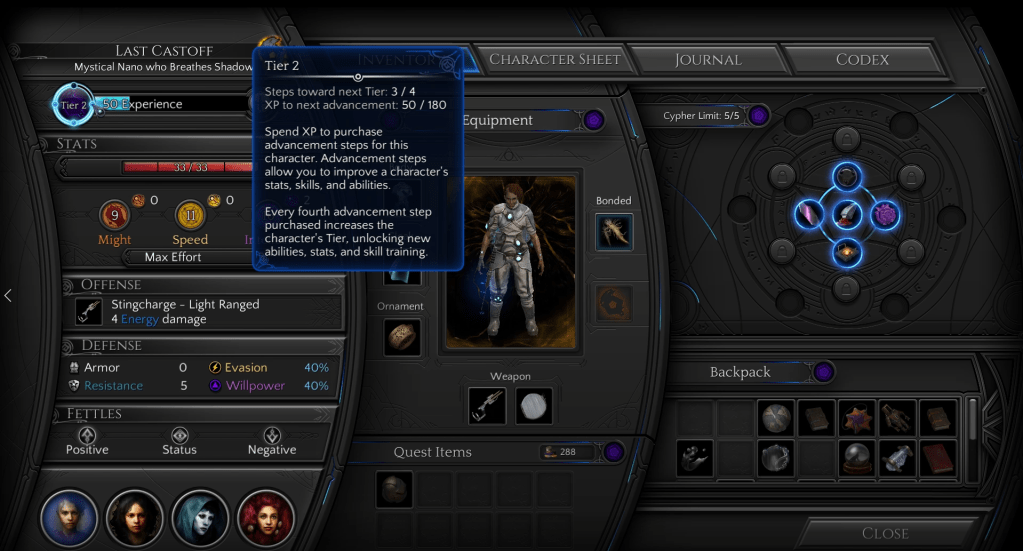
What I am referring to as the “Castoff Method” is simply the XP structure as it appears in the video game Torment: Tides of Numenera. The purpose of this is to provide a different structure for character advancement while still keeping the task resolution mechanic and character construction in place.

This is particularly great for groups that want a slightly more traditional fantasy-style RPG system; as such, they may want to consider including some standard XP award mechanisms like earning it from victory in combat, finishing a quest, or completing a session.

The Math

Essentially we’re multiplying the cost of 1 XP by 45. So everything that costs 1 XP in the game now costs 45 XP.

Characters still advance through 6 Tiers, purchasing four Advancements before going on to the next Tier. Normally, this costs 4 XP per advancement, but here we’re going to have it cost 180 XP.

Tier #
Advancement 1 = 180 XP
Advancement 2 = 180 XP
Advancement 3 = 180 XP
Advancement 4 = 180 XP

720 XP per Tier. 4,320 XP for total character advancement. With this much XP in play, you will want to award XP a bit more often, and may wish to consider granting XP for the defeat of creatures. Base this XP award on the target number of the creature defeated. (A Level 1 creature will award 3 XP).

This is a very different approach than what the Cypher System offers; however, it can make the game feel a little bit more familiar to traditional fantasy RPG mechanics if you prefer that. Torment: Tides of Numenera works as a sort of proof of concept to demonstrate that you can in fact count XP this way and still hold on to a good bulk of the Cypher System.

Building a Numenera Adventure

7 Steps for Writing a Numenera Adventure

Step One: Choose the Setting

Narrow down where the adventure is likely to take place. Be only as specific as necessary and choose three themes associated with where the adventure is set.

Step Two: Pick a Story Topic

Use the in-book setting lore or find inspiration from an interesting, preferably weird, topic to largely base the story on. Focus on three themes associated with the story and jot them down.

Step Three: Generate Numenera

Using the charts available in the Numenera rulebooks, aim to generate at least 5 cyphers, 5 oddities, and an artifact.

Taking Stock of Everything Created So Far

Review your setting and story themes, along with your generated list of numenera, and see if any interesting ideas for an adventure comes up.

Step Four: Writing Out an Adventure Strand

The “Adventure Strand” is my take on Dan Wells’ 7-point story structure, modified slightly to work better with an RPG. These steps do not need to be written or even played necessarily in linear order, but they will provide a great foundation for imagining what could happen based on the adventure.

Write fast without much hesitation, and turn to the setting and story themes, as well as the generated list of numenera for ideas.

7-Point Adventure Strand

The Hook: topics to get the player involved

Shift 1: changes the adventure by introducing something new

Complication 1: makes something weird or introduces conflicts and/or challenges

Midpoint: players start to make decisions based on what they’ve learned so far

Complication 2: something makes it challenging for the players to act based on their decisions

Shift 2: the adventure changes again, possibly allowing the party an opportunity to act

Resolution: the consequences of the players’ actions reveal themselves

Step Five: Fleshing Out the Adventure

Use your story and setting themes as well as the list of generated numenera, start coming up with interesting NPCs, developments of the adventure “Shifts” from the Adventure Strand and keep turning to the earlier steps to find inspiration to breathe life and more detail into the adventure.

Step Six: Adventure Themes and Rewards

Observe the total adventure so far and come up with at least three main themes, brainstorming ideas for the overall tone of the adventure, as well as what the discovery/XP rewards will be based on.

Step Seven: Finishing Touches

Come up with any other NPCs, areas, or other places/people of interest that will fill in any gaps you see in the adventure as it stands. Find places to insert any numenera you’ve generated that hasn’t found a role or place in the adventure thus far. Consider any difficulty challenges that may arise out of specific encounters and stat them out as you feel is necessary to prepare to run the adventure.

And that’s about all you need to create adventures for Numenera!